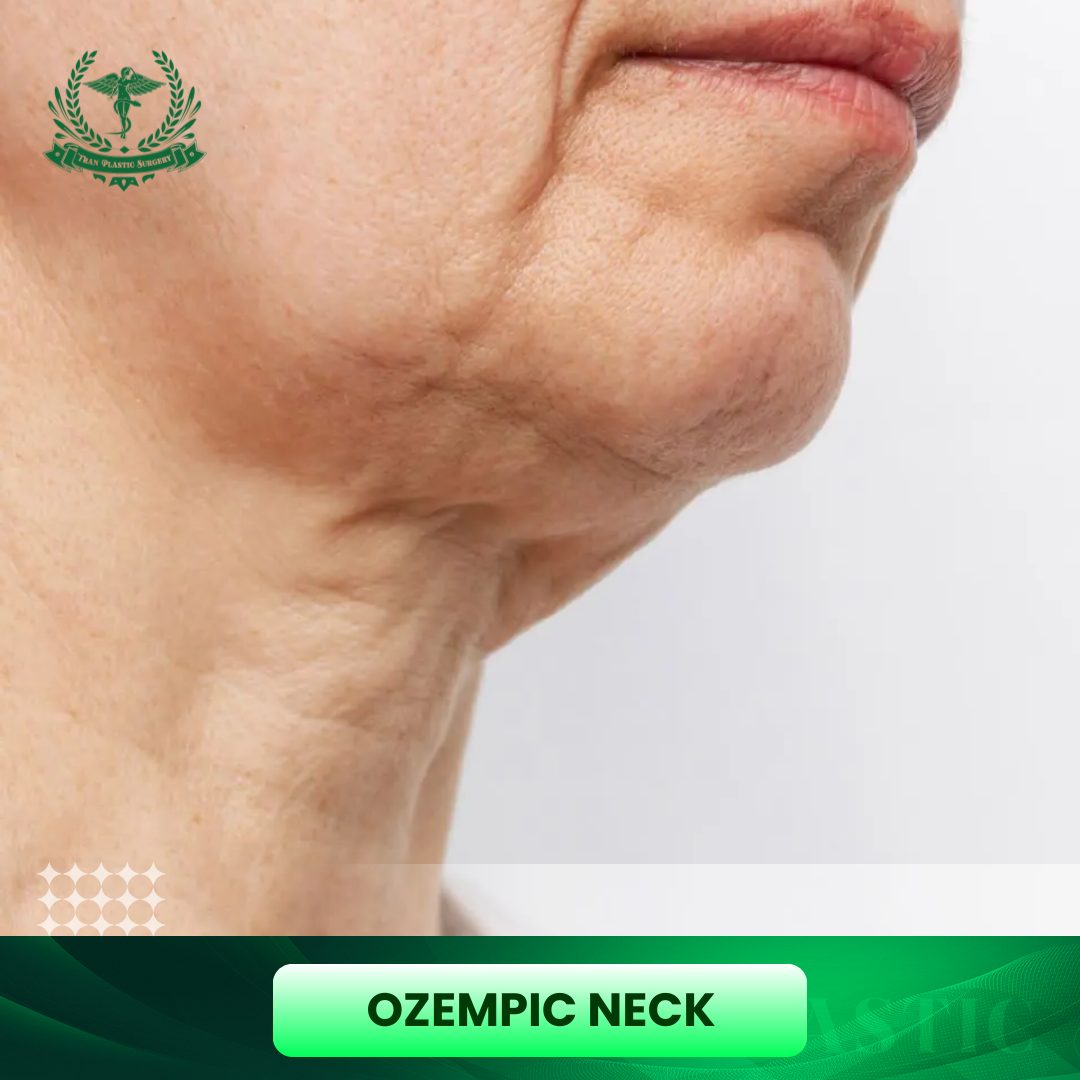
Ozempic neck is not just a side effect of rapid weight loss. It is the moment you look in the mirror and realize your new slimmer body no longer matches the loose, sagging skin under your chin and along your jawline. The neck begins to look soft, stretched, and aged, creating a “turkey neck” appearance that can overshadow the success of your weight loss. Once this excess skin develops, non-invasive treatments rarely create meaningful improvement and often lead to frustration. The most effective and transformative solution is a Neck Lift combined with Platysmaplasty. This surgical approach removes the redundant skin, tightens the underlying muscles, and restores the sharp, defined jawline you expected to see after your weight transformation.
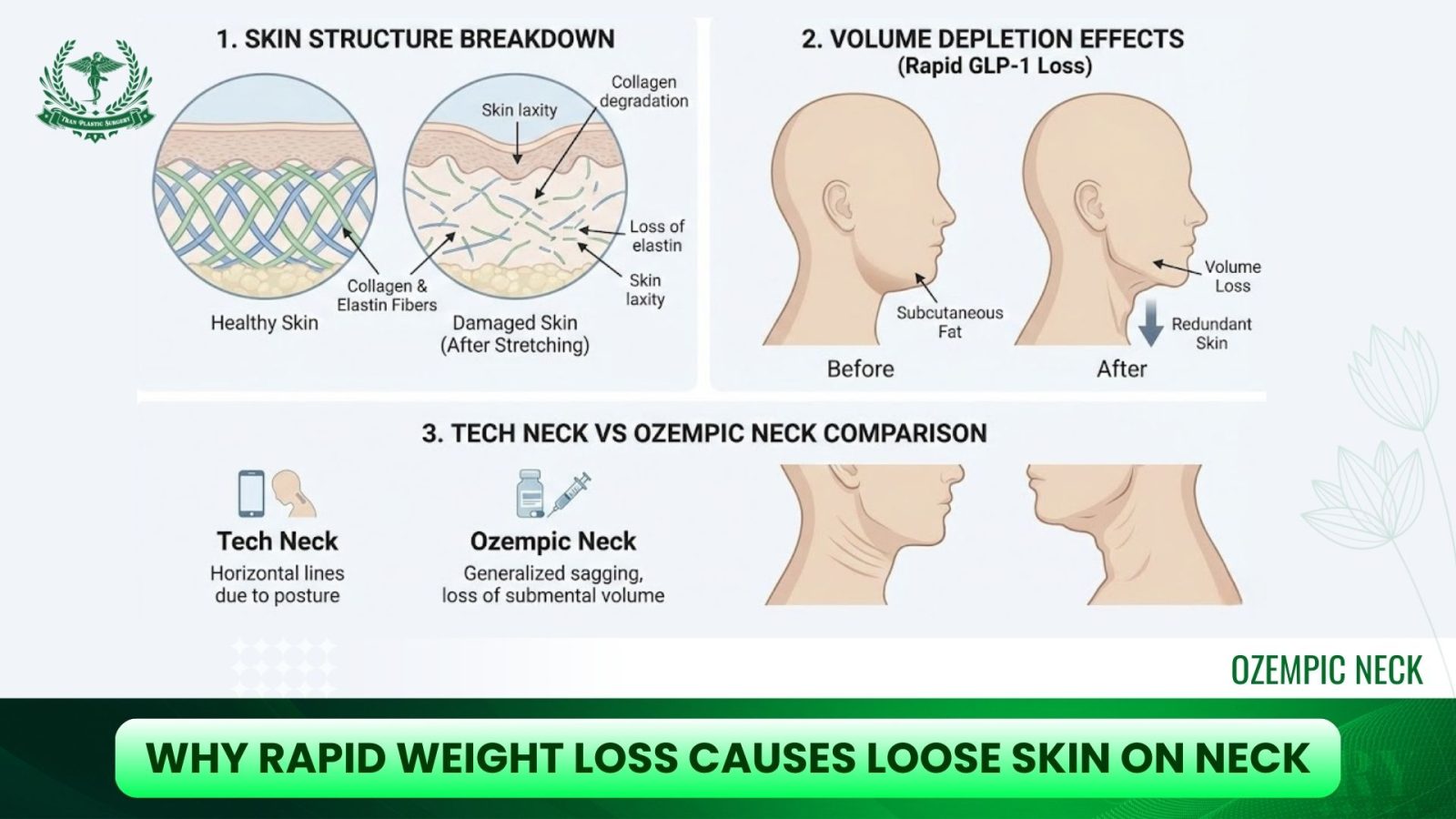
The introduction of GLP-1 receptor agonists, such as Ozempic, Wegovy, and Mounjaro, represents a monumental breakthrough in weight management, enabling patients to achieve previously unattainable levels of rapid, significant weight loss. This transformative success brings profound health benefits, but patients often experience unintended aesthetic consequences from changes in body contours. One of the most frequently reported concerns is the appearance of loose or sagging skin around the neck and jawline, colloquially termed the “Ozempic neck”.Why Rapid Weight Loss Causes Loose Skin on Neck?The term Ozempic neck is not a clinical diagnosis, but a popular descriptor for neck skin laxity that follows rapid fat reduction. This appearance is not a direct pharmacological side effect of the medication; rather, it is a natural consequence of losing a substantial amount of submental (under-chin) and facial fat faster than the skin’s inherent elasticity can contract. When fat diminishes quickly, the remaining skin, deprived of its underlying support, begins to drape and sag, often resulting in a premature appearance of aging.For patients who have successfully redefined their health and body shape, finding that their neck region does not match their new slimmer profile can be frustrating. The solution lies in surgical contouring. A Neck Lift is the definitive medical procedure utilized to remove this excess skin, tighten the crucial underlying musculature, and fundamentally restore the sharp, defined jawline lost during the rapid weight loss phase.6 This comprehensive approach addresses the structural deficit left behind, providing a lasting correction for saggy neck after weight loss.
The Science of Sagging: Why Rapid Weight Loss Causes Loose Skin on Neck?
Understanding why rapid weight loss leads to profound neck laxity is crucial for determining the appropriate treatment modality. The skin’s ability to retract and conform to a smaller body volume is dependent on the integrity and quantity of structural proteins: collagen and elastin.
1. The Anatomical Mechanism of Skin Laxity
The appearance of loose skin on neck after several anatomical and physiological factors govern weight loss. When the skin is stretched over a long period due to excess weight, its elastin and collagen fibers can become compromised or damaged.Several factors contribute to the severity of the resulting laxity:
Speed of Loss: Rapid weight loss of substantial body weight typically results in a significantly greater amount of loose skin than gradual, more moderate weight reduction. The skin simply does not have sufficient time to contract and adapt to the new shape.
Amount of Loss: Patients experiencing 15 to 25% total body weight loss, familiar with medications like Mounjaro, are at high risk for noticeable sagging. The sheer reduction in volume leaves a large surface area of redundant tissue.
Age and Genetics: Older skin possesses less collagen than younger skin, significantly reducing its elasticity and inherent ability to retract. Additionally, genetic predisposition plays a role in determining how well a person’s skin responds to volume fluctuations.
The resulting appearance often involves excessive draping of the skin, coupled with a loss of definition at the cervicomental angle. This is widely recognized as the characteristic look of a turkey neck.The Anatomical Mechanism of Skin Laxity
2. The Gaunt Appearance Volume Depletion in the Jawline
A defining characteristic of Ozempic neck and the related Ozempic face phenomenon is the rapid depletion of fat in the facial and submental areas. Fat loss around the jawline and chin often occurs before fat loss in other regions of the body.This depletion of subcutaneous volume reveals and exaggerates pre-existing signs of aging, such as deeper facial folds, jowls, and a gaunt or hollow appearance. The loss of fat serves as the trigger that unveils underlying structural issues, making loose elastin fibers and skin redundancy much more apparent. For this reason, effective correction often requires not just tightening but also the meticulous restoration of volume to achieve a balanced, rejuvenated look.
3. Defining the Difference: Tech Neck vs Ozempic Neck
While both terms describe issues affecting the neck contour, the pathology and resulting appearance of Tech neck vs Ozempic neck are distinctly different.
Ozempic Neck: Characterized by widespread skin redundancy, generalized sagging, and the loss of volume that accompanies rapid weight loss. The primary issue is a mechanical mismatch between a large skin envelope and a reduced underlying structure.
Tech Neck: Primarily a postural concern. It involves the formation of horizontal compression wrinkles or lines caused by constantly flexing the neck to look down at mobile devices.
This anatomical distinction dictates the treatment approach: Tech Neck lines may respond to treatments such as Botox or superficial tightening, but the significant structural laxity and skin excess of Ozempic neck require surgical intervention.
Evaluating Neck Tightening Procedures When Non-Surgical Options Fall Short
Patients often seek less invasive solutions first for crepey skin on neck or mild laxity. It is essential to delineate the capabilities and, more importantly, the limitations of non-surgical and minimally invasive procedures when faced with the degree of skin redundancy typical of Ozempic neck.Evaluating Neck Tightening Procedures When Non-Surgical Options Fall Short
1. Non-Surgical and Minimally Invasive Procedures
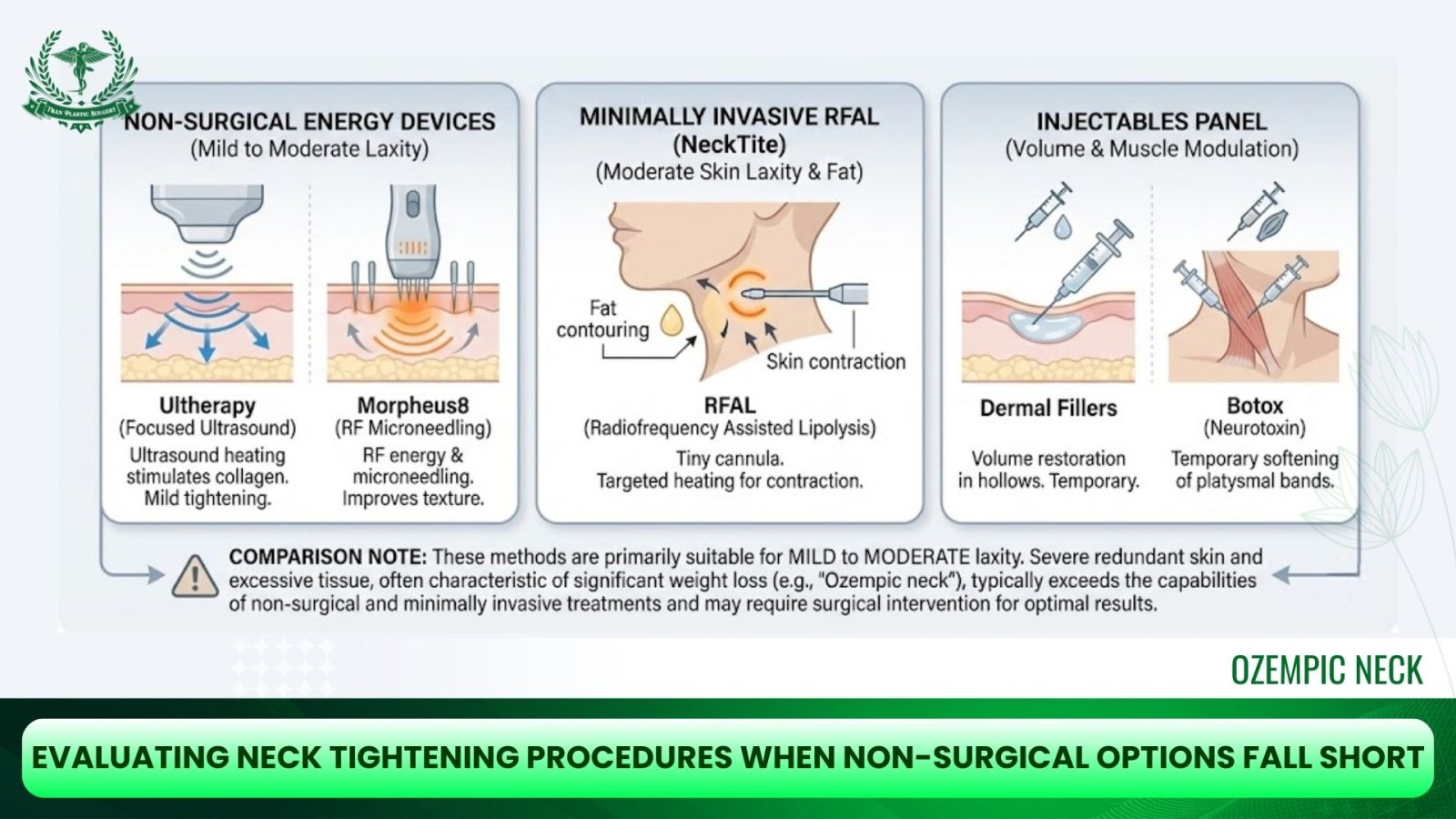
For mild to moderate laxity, several technologies provide effective skin firming by promoting collagen production. These procedures fall under the umbrella of non-surgical neck lift options:
Radiofrequency (RF) and Ultrasound: Devices such as Ultherapy (focused ultrasound) and Morpheus8 (RF microneedling) use thermal energy to heat the dermal layers, stimulating new collagen production. The FDA clears them to treat the chin, neck, and chest, and they can be excellent for managing early signs of aging or mild crepiness. Morpheus8, specifically, targets both superficial and deeper skin concerns to improve firmness and elasticity.
Minimally Invasive Technologies: Procedures like NeckTite use radiofrequency-assisted lipolysis (RFAL) via small cannulas to simultaneously tighten skin and remove small pockets of fat, offering results superior to liposuction alone for patients with mild laxity.
Injectables: Dermal fillers, such as hyaluronic acid, can be utilized to restore minor lost volume and improve the appearance of texture or lines. Botox can temporarily soften mild vertical platysmal muscle bands. These treatments are generally temporary, lasting six to eighteen months depending on the patient and product used.
3. The Efficacy Wall Why Devices Fail Severe Laxity
While non-surgical neck tightening procedures are valuable, they encounter an “efficacy wall” when confronted with severe skin laxity resulting from substantial, rapid fat loss. Non-surgical methods rely on the skin’s natural contractility.For patients presenting with significant skin redundancy, often referred to as a true turkey neck, the excess tissue is beyond the capacity of collagen stimulation to retract fully. The skin, having been severely stretched and deflated, is comparable to an overstretched elastic garment that cannot be shrunk back to fit the new, more petite frame. For these individuals, results from energy-based devices are often minimal and do not provide the desired contour correction.Furthermore, fat-reduction injectables like Kybella, which dissolve submental fat, are ill-suited for patients with poor skin elasticity, as dissolving fat without removing excess skin can worsen the sagging appearance. The magnitude of change required following significant weight loss places the corrective procedure squarely in the domain of surgery.Surgical vs. Non-Surgical Efficacy for Loose Neck Skin
Criteria
Surgical Neck Lift (Platysmaplasty Included)
Non-Surgical Tightening (RF/Ultherapy)
Applicable Laxity Severity
Moderate to Severe (True skin redundancy)
Mild to Moderate (Crepey skin, early laxity)
Muscle Tightening (Platysmaplasty)
Yes (Addresses vertical bands definitively)
No (Botox addresses mild banding temporarily)
Excess Skin Removal
Yes (Physical excision and redraping)
No (Relies solely on contraction/collagen)
Required Downtime
7–14 days
Minimal to None
Longevity of Results
10 to 15 years or more
6 to 18 months (Requires repeated sessions)
Neck Lift Surgery: The Gold Standard for Restoring the Jawline
When addressing the severe skin excess and structural changes associated with Ozempic neck, a comprehensive surgical Neck Lift is the most effective and definitive solution for how to fix Ozempic neck.
1. Patient Candidacy and Optimal Timing
The ideal candidate for a neck lift for loose skin is an individual who is at or near their ideal body weight and, crucially, has maintained a stable weight for at least six months. A Neck Lift is not a weight-loss procedure; significant weight fluctuations after surgery risk compromising long-term results by causing the skin to loosen again or the remaining fat structure to change. Stability ensures the surgeon is contouring the final, permanent neck dimensions, leading to predictable outcomes.
2. Defining the Modern Neck Lift
Neck lift surgery focuses on removing excess skin and fat, tightening the platysma muscles, and repositioning tissues to create a firm, smooth, and defined cervicomental angle. The procedure is often performed under general anesthesia or IV sedation and typically lasts between two and three hours. Incisions are designed to be minimally visible, often concealed behind the ears and beneath the chin.
3. The Specialized Surgical Components for Post-Weight Loss Correction
For patients who have undergone rapid weight loss, neck changes require more than a simple skin tuck; they require structural repair.
3.1. Platysmaplasty: Tightening the Muscle Bands
A key element in correcting the “turkey neck” look is Platysmaplasty. This procedure focuses specifically on tightening the loose bands of the platysma muscle, which are often separated and become highly visible after fat loss. While a Platysmaplasty may be performed alone for younger patients with only muscle banding and excellent elasticity, it is typically included as an integral step within a full Neck Lift for patients with significant skin laxity. This muscle repair eliminates the vertical cord-like appearance, resulting in a significantly smoother neck profile.
3.2. Deep Neck Lift and Vertical Repositioning
For the complex patient presenting with severe sagging and structural volume loss the hallmark of the post-GLP-1 aesthetic a Deep neck lift approach is often employed. This technique addresses structures deeper than the platysma muscle, allowing the surgeon to sculpt deep fat deposits and reposition tissues vertically.Traditional lifting techniques often pull skin sideways, which can create unnatural tension. In contrast, the deep vertical approach lifts tissues upward, creating robust support for the new contour and providing a profound definition of the jawline without a tight or “pulled” appearance. The necessity of addressing these deep tissues and removing excess skin underscores the level of anatomical precision required to correct the accelerated-aging appearance.
The gaunt appearance often observed after rapid weight loss is due to volume depletion in the face and neck. While the Neck Lift addresses the laxity, facial fat grafting is often utilized to restore harmonious contours.Fat grafting involves harvesting a patient’s own excess fat and transferring it to areas of the face that have become hollowed, such as the cheeks, temples, or jawline. This procedure counteracts the deflation effect, ensuring that the newly contoured neck complements a naturally rejuvenated, less gaunt facial profile. This comprehensive strategy, combining tightening and volume restoration, achieves the most natural and long-lasting results.
The Transformation Ozempic Neck Before and After, and Long-Term Results
1. Anticipating the Ozempic Neck Before and After Transformation
Patients undergoing a Neck Lift for post-weight loss laxity can anticipate a dramatic and satisfying transformation. The key aesthetic goals achieved include a sharp definition of the mandibular border (jawline), the elimination of the sagging skin, and the restoration of a defined cervicomental angle. The result is a profile that accurately reflects the patient’s successful commitment to health and wellness, offering a powerful emotional benefit: the exterior finally matches the healthy, vibrant person within.
2. Durability and Longevity of the Neck Lift
A well-executed Neck Lift is celebrated for its longevity. While individual aging continues, the structural enhancements achieved by tightening the platysma and removing excess skin typically last between 10 and 15 years. Some reports indicate that results can endure for a decade or more, demonstrating a significant return on investment compared to temporary non-surgical interventions.Factors that promote this long-term success include maintaining stable weight after surgery, meticulous skincare (especially sun protection), and adherence to a healthy lifestyle.The Gold Standard for Restoring the Jawline
Recovery, Safety, and Maximizing Results
A thorough understanding of the recovery process and potential risks is paramount to achieving the best possible outcome.
1. Neck Lift Recovery Timeline
A Neck Lift is generally performed as an outpatient procedure. Immediately following the surgery, patients will experience swelling, bruising, and a temporary feeling of tightness, which is a sign that the Platysmaplasty has successfully tightened the underlying musculature.
Initial Phase (First 1–2 Weeks): Most swelling and bruising begin to subside rapidly within the first two weeks. Patients are typically ready to return to work and resume normal, non-strenuous daily activities within 10 to 14 days. During this period, the head must remain elevated, and bending or twisting of the neck should be strictly avoided.
Long-Term Healing: Strenuous activities and heavy lifting must be avoided for several weeks, typically 4 to 6. While significant improvement is visible within weeks, the full aesthetic outcome, including the final settling of the neck contour, can take up to three months. Incision lines continue to fade for up to a year.
2. Safety and Risk Management
As with any major surgery, a Neck Lift carries potential risks, which must be openly discussed to ensure patient safety and preparedness. The risks involved with this procedure include:
Anesthesia Risks: Adverse reactions related to general or IV sedation.
Immediate Post-Operative Complications: Bleeding, hematoma (fluid accumulation), or seroma.
Nerve Function: Rare but possible nerve injury, which could cause temporary or permanent weakness, occasionally affecting the lower lip.
Healing and Sensation: Poor wound healing, infection, unfavorable scarring, and temporary or permanent numbness or changes in skin sensation.
Aesthetics: Facial or neck asymmetry, which can sometimes be attributed to the recovery process or may require corrective surgery.
These risks are significantly mitigated by selecting a highly experienced, board-certified plastic surgeon who maintains hospital privileges and specializes in neck contouring procedures.
Financial Planning Understanding the Neck Lift Cost and Investment
When considering surgical correction for Ozempic neck, understanding the total investment is a critical component of the decision-making process. The ultimate Neck lift cost reflects the complexity of the correction and the geographic location of the practice.
1. Average Neck Lift Cost in the USA
The national average cost for a traditional Neck Lift in the United States ranges broadly, generally falling between $5,000 and $12,000. This figure typically encompasses the surgeon’s fee, anesthesia, facility fees, and post-operative care.Geographic location is a significant cost factor. In high-cost metropolitan areas, such as New York or Los Angeles, the average cost for a comprehensive Neck Lift procedure is typically on the higher end, ranging from $8,000 to $15,000. In contrast, smaller cities or rural regions may see costs closer to the lower end of the national average.
2. Factors Determining the Final Investment
The complexity required to correct the changes induced by rapid weight loss directly impacts the investment:
Surgical Technique: A standard Neck Lift costs less than a more complex structural intervention, such as a Deep neck lift often required for comprehensive post-weight-loss contouring.
Combination Procedures: The surgical fee increases when combining the Neck Lift with essential complementary procedures, such as extensive submental liposuction, Fat Grafting to address volume loss, or an accompanying facelift.
Surgeon and Facility: Fees reflect the surgeon’s experience level and the surgical facility’s accreditation and associated safety standards.
Estimated Average Neck Lift Cost (USA Market, 2025)
Cost Component
Typical US Range
Factor Influencing Variation
Surgeon’s Fee
$3,000 – $8,000
Experience, Board Certification, Procedure Complexity (e.g., Deep Lift)
Anesthesia/Facility Fees
$2,000 – $5,000
Type of Sedation, Operating Room Accreditation, Geographic Location
Total Procedure Estimate
$5,000 – $12,000+
Extent of Correction, Combining procedures (e.g., Fat Grafting)
3. Value Proposition Surgery versus Endless Maintenance
For patients with severe skin redundancy, the surgical Neck Lift offers superior long-term value. While the initial investment is substantial, the results can last 10 to 15 years. This contrasts sharply with non-surgical treatments, which offer modest, temporary results for severe laxity and require continuous, costly maintenance sessions every 6 to 18 months, leading to a poorer long-term efficacy and investment return.Value Proposition Surgery versus Endless Maintenance
Conclusion Achieving Full Transformation and Lasting Confidence
Rapid weight loss achieved through medications like Ozempic, while life-changing for health, can create aesthetic challenges in the neck and jawline that often resemble accelerated aging. The resulting Ozempic neck, characterized by profound skin redundancy and volume loss, represents a mechanical deficit that non-surgical methods are fundamentally incapable of correcting.The definitive solution is a specialized surgical Neck Lift, often utilizing advanced techniques such as Platysmaplasty and a Deep neck lift, potentially supplemented with facial fat grafting. This comprehensive approach not only removes excess skin but also structurally tightens the underlying muscle and restores lost volume, yielding a sculpted, youthful jawline that complements the patient’s new, healthier physique.The most critical recommendation for any patient seeking to correct their saggy neck after weight loss is to partner with a board-certified plastic surgeon specializing in complex neck and facial contouring. This ensures the highest level of anatomical expertise and surgical precision, maximizing safety and ensuring the longevity of the transformative results.
Frequently asked questions about Ozempic Neck are of interest to patients.
Ozempic neck side effects are misunderstood. It is not an inherent pharmacological side effect of GLP-1 medications like Wegovy neck or Mounjaro neck. Rather, it is an aesthetic consequence of achieving significant and rapid weight loss. The underlying cause is the loss of fat volume around the jawline and chin at a speed that outpaces the skin’s ability to naturally contract. This mechanical mismatch between skin envelope and reduced structure creates the appearance of loose skin.
To ensure the most predictable and lasting surgical outcomes, surgeons strongly advise patients to wait until their weight has stabilized and plateaued for a minimum of six months. This critical waiting period confirms that your final contours are set. Proceeding with surgery before stability risks future weight fluctuations compromising the cosmetic results, potentially causing the skin to loosen again.
The optimal approach for managing severe saggy neck after weight loss involves a comprehensive surgical strategy. This strategy combines Platysmaplasty to surgically tighten the loose vertical neck muscle bands, and often includes a Deep neck lift. The deep technique allows the surgeon to sculpt underlying tissues, remove excess fat, and redrape the skin vertically to achieve a profoundly defined and natural-looking jawline.
A surgical Neck Lift offers definitive and permanent correction by physically excising loose skin on neck and tightening the underlying structures. Non-surgical neck lift options, suchs as focused ultrasound (Ultherapy) or radiofrequency microneedling (Morpheus8), rely solely on stimulating collagen production, which yields only modest tightening. These non-invasive methods cannot address the severe skin redundancy or muscle laxity (Platysma bands) typical of post-weight loss patients.
Patients who undergo a Neck Lift procedure, often including Platysmaplasty, can typically resume normal, non-strenuous activities, including returning to desk work, within 10 to 14 days. While noticeable bruising and swelling substantially diminish within the first two weeks, patients must avoid strenuous activities and heavy lifting for 4 to 6 weeks. Final aesthetic results will continue to refine and improve over the course of several months.
The Neck lift cost is subject to significant geographic variation. In major US metropolitan regions such as Los Angeles, Miami, or New York, the average investment for a comprehensive Neck Lift typically ranges from $8,000 to $15,000. This estimate typically incorporates the surgeon’s fee, the anesthesiologist’s fee, and the accredited facility costs.
Yes, a surgical Neck Lift is the ideal procedure for treating both the Turkey neck appearance and excessive loose skin on neck. The procedure directly removes and redrapes the excessive skin while simultaneously utilizing the Platysmaplasty technique to surgically tighten and repair the prominent vertical muscle bands.
A Neck Lift’s primary function is to correct profound laxity and restore contour by physically removing redundant skin. While the removal of excess skin significantly smooths the neck, it does not specifically treat superficial skin texture issues like crepey skin on neck. For optimal skin quality enhancement, supplementary non-surgical treatments such as laser resurfacing or specialized RF microneedling (e.g., Morpheus8) may be recommended in a staged approach.
While generally safe when performed by an experienced surgeon, common risks for a Neck Lift include temporary swelling, bruising, and numbness. More serious, though rare, potential risks include hematoma (blood accumulation), infection, adverse scarring, and temporary nerve injury which could potentially affect movement in the lower lip. Choosing a board-certified specialist who focuses on complex contouring is the best way to mitigate these risks.
Tech neck vs Ozempic neck represents different pathologies. Tech Neck involves superficial horizontal compression lines caused by posture and is typically treated non-surgically with Botox or skin tightening. Ozempic neck involves profound structural laxity and skin redundancy resulting from fat volume loss. This condition requires surgical correction, specifically a Deep neck lift and Platysmaplasty, to remove the excess tissue and restore the defined jawline.
Board-Certified Plastic Surgeon in Orange County, CA
With over a decade of expertise, Dr. Tuan Tran is a renowned surgeon dedicated to the highest standards of surgical excellence. He meticulously reviews and vets all content to ensure patients receive accurate, evidence-based insights and the latest safety protocols in modern medicine.