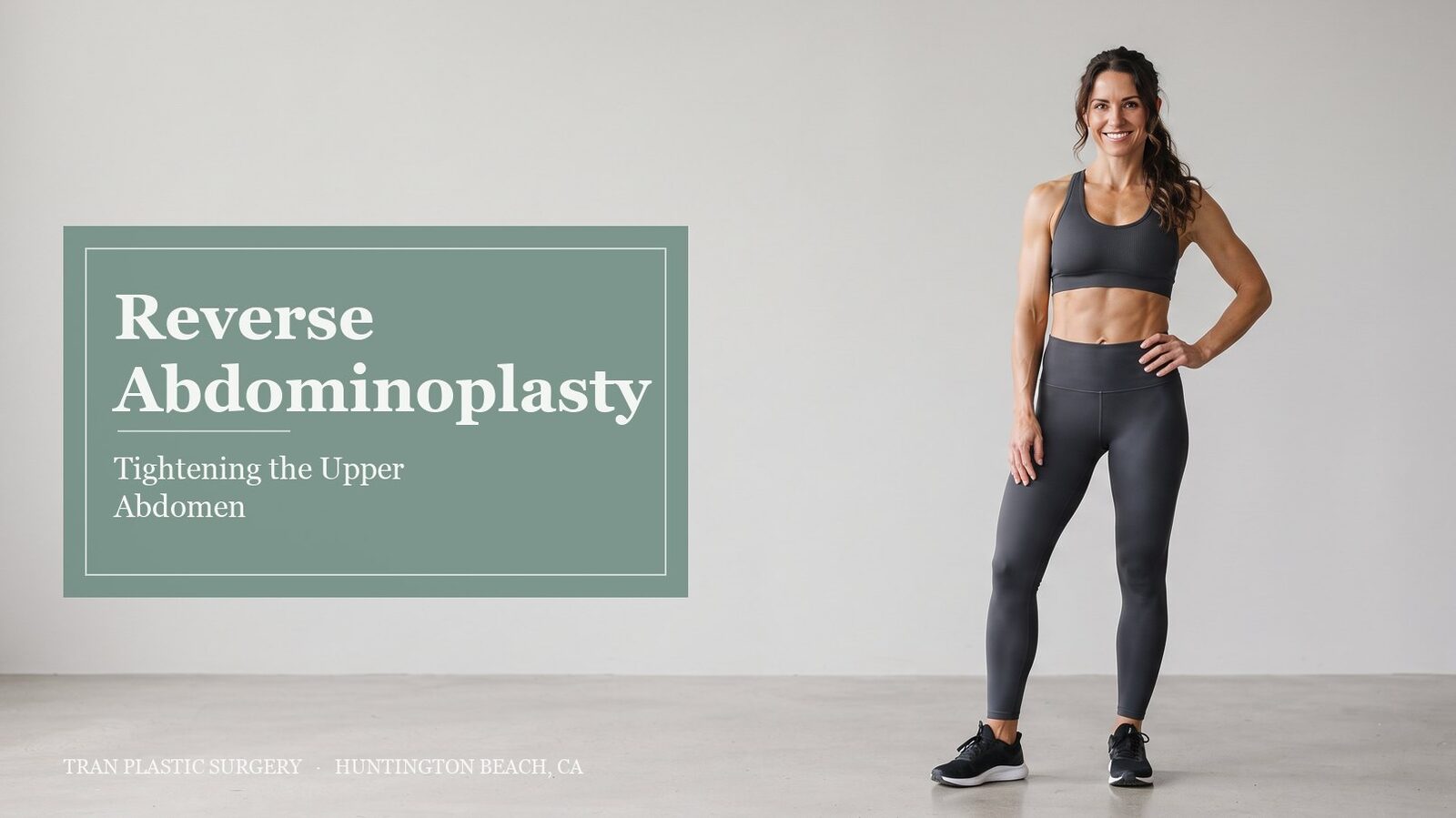
Reverse abdominoplasty is a specialized tummy tuck technique that tightens loose skin in the upper abdomen by placing the incision along the crease beneath the breasts rather than across the lower belly. For patients whose main concern is sagging or excess skin above the navel — often after significant weight loss or pregnancy — this approach lifts the abdominal skin upward for a smoother, firmer contour, with the scar discreetly hidden in the breast fold. Because of that incision location, reverse abdominoplasty also pairs naturally with breast procedures. At Tran Plastic Surgery in Huntington Beach, the technique is tailored to each patient’s anatomy for a balanced, natural result.
What Is Reverse Abdominoplasty?
A traditional tummy tuck removes loose skin and fat from the lower abdomen through an incision low on the belly, pulling the skin downward. Reverse abdominoplasty does the opposite: the incision is placed in the inframammary fold (the crease under the breasts), and the upper abdominal skin is lifted and tightened upward. Excess skin is removed at the top, and the remaining skin is re-draped for a flatter, firmer upper abdomen.
Because the navel is not detached or repositioned in most reverse abdominoplasty procedures, there is no scar around the belly button. The technique is less common than a standard tummy tuck and is chosen specifically when the upper abdomen is the primary area of concern.

Reverse Abdominoplasty vs. Traditional Tummy Tuck
Both procedures tighten loose abdominal skin, but they target different areas and use different incision placement.
Traditional Tummy Tuck
Addresses the lower abdomen through a horizontal incision above the pubic area, often repositioning the navel and tightening the abdominal muscles. It is ideal for lower-abdominal skin laxity and post-pregnancy muscle separation. A mini tummy tuck is a smaller version for minimal lower laxity.
Reverse Abdominoplasty
Addresses the upper abdomen through an incision under the breasts, lifting the skin upward. It is ideal for patients with upper-abdominal laxity, those who have already had a lower tummy tuck but still have upper looseness, or those combining the procedure with a breast lift or reduction.
During your consultation in Huntington Beach, Dr. Tuan Tran will determine which approach — or combination — best suits your anatomy and goals.
Who Is a Good Candidate for Reverse Abdominoplasty?
Reverse abdominoplasty is well-suited to patients who have:
- Loose or excess skin concentrated in the upper abdomen, above the navel
- Skin laxity following significant weight loss or pregnancy
- Residual upper-abdominal looseness after a previous standard tummy tuck
- A desire to combine abdominal tightening with a breast lift or reduction, using a shared incision
- Good overall health, a stable weight, and no active smoking
- Realistic expectations about scarring and results
Patients whose looseness is mainly in the lower abdomen are usually better served by a traditional or mommy makeover approach. A thorough in-person evaluation is the best way to determine candidacy.
How Does Reverse Abdominoplasty Work?
Step 1 — Consultation and Assessment
Your surgeon evaluates the location and degree of skin laxity, your skin quality, and whether the procedure will be combined with a breast surgery. A customized surgical plan is created.
Step 2 — Anesthesia
Reverse abdominoplasty is performed under general anesthesia for your comfort throughout the procedure.
Step 3 — Incision Placement
An incision is made along the natural crease beneath the breasts (the inframammary fold), where the resulting scar is well concealed.
Step 4 — Lifting and Tightening the Skin
The upper abdominal skin is gently released, lifted upward, and re-draped. Excess skin is removed at the incision line, and the abdominal contour is smoothed. Liposuction may be added to refine the result.
Step 5 — Closing
The incisions are closed in layers to support healing and keep the scar as fine as possible. If combined with a breast procedure, both are completed in the same session.
Step 6 — Recovery Setup
A supportive compression garment is applied to reduce swelling and support the new contour as it heals.
Reverse Abdominoplasty Recovery Timeline
Week 1 — Initial Healing
Swelling, bruising, and tightness are expected. Compression is worn continuously, and most patients take about two weeks off work depending on their activity level.
Weeks 2 to 4 — Early Recovery
Swelling gradually subsides and daily activities resume. Heavy lifting and strenuous exercise remain restricted.
Weeks 4 to 6 — Return to Activity
Most patients resume normal exercise as cleared by their surgeon.
Months 3 to 6 — Final Results
Residual swelling resolves, the contour settles, and the scar beneath the breasts continues to fade.
Benefits of Reverse Abdominoplasty

- Targets upper-abdominal laxity that a standard tummy tuck cannot fully address
- Scar hidden discreetly in the crease beneath the breasts
- No scarring around the navel
- Pairs efficiently with a breast lift or reduction through a shared incision
- A firmer, smoother upper abdominal contour
- An effective option for revising residual looseness after a previous tummy tuck
Reverse Abdominoplasty in Huntington Beach
If you are in Huntington Beach or the surrounding Orange County area and considering reverse abdominoplasty, look for a board-certified plastic surgeon experienced in advanced body-contouring techniques. A thorough in-person evaluation — covering where your skin laxity is concentrated and whether to combine procedures — is the most important step before surgery. Schedule a consultation with Dr. Tuan Tran to find out if reverse abdominoplasty is right for you, or contact our Huntington Beach office with any questions.
Frequently Asked Questions About Reverse Abdominoplasty
How much does reverse abdominoplasty cost in Huntington Beach?
Cost depends on the extent of the procedure and whether it is combined with surgery such as a breast lift or liposuction. You will receive a personalized quote after your in-person evaluation, and financing options are available.
Will the scar be visible in a bra or bikini top?
No. The incision sits in the crease beneath the breasts, so it is typically hidden by a bra or bikini top and by the natural shadow of the breast. It also fades over time.
Are the results of reverse abdominoplasty permanent?
The removed skin is gone for good, and results are long-lasting when your weight stays stable. Significant weight change or pregnancy afterward can affect the outcome.
Is reverse abdominoplasty painful?
Most patients describe tightness and soreness for the first several days that steadily improves. Discomfort is well controlled with medication, and the compression garment adds support.
Can reverse abdominoplasty be combined with liposuction?
Yes. Liposuction is often added to refine the upper abdomen and flanks, creating a smoother, more sculpted overall contour in the same session.
Does reverse abdominoplasty remove stretch marks?
Any stretch marks located on the skin that is removed will be gone. Stretch marks outside the excised area remain, though they may shift slightly as the skin is re-draped.
How should I prepare for reverse abdominoplasty surgery?
You will be asked to stop smoking, avoid medications and supplements that increase bleeding, arrange help at home for the first few days, and keep a stable weight. Your surgeon provides detailed pre-operative instructions.
Can I have reverse abdominoplasty if I have already had a tummy tuck?
Yes. It is a good option for correcting residual upper-abdominal looseness that a previous lower tummy tuck did not fully address.